For small businesses, the end-of-year crush is the time to “get in the black” as the holidays push sales into overdrive. It’s also a pressure cooker of deadlines for contractual obligations and regulatory requirements. In that atmosphere, it becomes easy for scammers to “slip one by,” especially in this age of tech-assisted fakery. Increasingly, cybercriminals and other fraudsters are using artificial intelligence to imitate the voices and appearances of business owners, executives, and financial officers to trick employees into authorizing fraudulent payments.
These scams, known as deepfake impersonation fraud, can be remarkably convincing. A familiar voice on the telephone or a seemingly authentic video call may no longer be reliable evidence of someone’s identity. For New Jersey small businesses, the consequences can include substantial financial losses, compromised banking information, and costly operational disruptions.
We’ve all heard how science fiction often becomes science fact, and if you were watching TV in the 1960s (or caught popular ‘60s programs later in syndication), you know how that works. An episode of Star Trek (“Court Martial”) featured a video log of an on-board incident, altered by computer to change the visual record of the event. In 1967, such technical wizardry seemed like the stuff of the 23rd century. But here we are early in the 21st century, and AI is nearly capable of doing just that.
Another popular show, Mission: Impossible featured disguises so sophisticated they escaped detection. IMF team members would impersonate targeted individuals by donning latex masks that reproduced exact physical features. (How they reproduced the target’s voice was never fully explained.) Today, deep fake masks have been used successfully to impersonate famous people, leading to a spate of rumors that various public appearances were actually the work of imposters.
A verified deep fake scam took place in France from 2015 to 2016. Fraudsters concocted a scheme in which one of their number posed as French defense minister Jean-Yves Le Drian to solicit financial aid for what they claimed were secret operations by the French state to free hostages. The imposter wore a lifelike silicone mask while appearing in Skype video calls from a staged ministerial office. The scheme netted the perpetrators €55m, but resulted in a successful fraud prosecution and lengthy prison sentences.
Since the Le Drian scheme, rumors have surfaced in the media and online of many celebrity sightings that could have been masked deep fakes, included appearances by U.S. Navy Vice Admiral (Ret.) Robert Harward (appearing remotely on Fox News’s America’s Newsroom), Jim Carrey (César Awards, Paris, February 26, 2026), and Joe Biden (during and after his presidency). It’s an idea at least as old as Mark Twain’s The Prince and the Pauper. But now we seem to have the technology to make an impersonation completely convincing. As a small business owner, it is incumbent on you to ensure such a scam doesn’t harm your company.
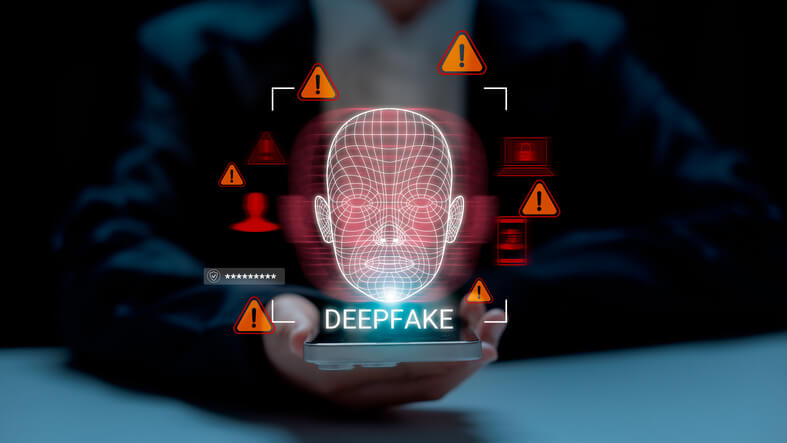
Deepfake technology uses AI to generate convincing audio, video, or images resembling real people. Criminals can create these imitations using relatively small amounts of publicly available material, including company videos, recorded interviews, social media posts, and online presentations.
Voice-cloning software can reproduce an executive’s speech patterns, accent, and vocal characteristics. Video-generation tools can create convincing facial movements and expressions, allowing criminals to impersonate someone during a video conference.
Fraudsters combine these capabilities with information gathered through phishing, compromised email accounts, social media research, and other reconnaissance. Their objective is usually straightforward: persuade an employee to transfer money, disclose confidential information, or bypass established financial controls.
If you operate a small business in New Jersey, here are the primary deepfake scams you need to guard against:
The executive wire-transfer request — In this scenario, an employee receives a telephone call or video conference invitation that appears to come from the company president, owner, or chief financial officer. The supposed executive explains that an urgent transaction must be completed immediately. The payment might involve an acquisition, an overdue vendor invoice, a confidential business transaction, or an unexpected legal obligation.
Criminals often manufacture urgency and secrecy, instructing the employee not to discuss the transaction with colleagues. A convincing voice or video image can make the request appear legitimate, particularly when it arrives during a busy accounting period.
Year-end vendor and invoice fraud — December is particularly attractive to criminals because accounting departments are processing outstanding invoices, reconciling accounts, paying contractors, and closing financial records. A fraudster might impersonate an executive requesting an immediate payment to a supposedly trusted vendor. Alternatively, criminals may impersonate the vendor and claim that its banking information has changed.
In more sophisticated schemes, criminals combine compromised business email accounts with cloned executive voices. An employee may receive an apparently legitimate email and then a telephone call reinforcing the payment instructions.
Fake video conferences — A criminal might arrange a video meeting involving several apparent company executives. AI-generated video can make participants appear to be familiar colleagues, while cloned voices reinforce the illusion. The employee may be told that the company is completing a confidential transaction and that payment instructions must be followed without delay.
A notable example occurred in Hong Kong in 2024, when an employee of a multinational company reportedly transferred approximately $25 million after participating in a video conference featuring deepfake representations of company executives. The incident demonstrated that convincing impersonations can even deceive employees who are accustomed to conducting business electronically.
Payroll and employee-payment scams — Fraudsters may impersonate business owners or human-resources personnel to request changes to employee direct-deposit information, authorize bonuses, or approve unusual payroll transactions. A successful scheme can divert legitimate wages into criminally controlled accounts.
Several circumstances make the final weeks of the year especially vulnerable to impersonation fraud:
Criminals exploit these conditions because employees may be more willing to depart from ordinary procedures when they believe an executive needs immediate assistance.
The most effective defense is to establish procedures that make identity verification independent of the communication channel used to request payment. A familiar voice, email address, or video image should never be sufficient authorization for a significant financial transaction.
Preventing deepfake fraud requires more than purchasing cybersecurity software. Small businesses need coordinated security policies, employee training, reliable authentication procedures, and continuous monitoring.
A New Jersey managed IT services provider, such as KMF Technologies can help implement multifactor authentication, secure business email systems, monitor suspicious account activity, and identify compromised credentials. Our IT pros can also help establish payment-verification procedures, conduct employee phishing simulations, and develop an incident-response plan for suspected impersonation attempts. These measures are particularly important for businesses that rely on electronic banking, remote employees, and cloud-based accounting systems.
Deepfake technology has changed the nature of business impersonation fraud. Employees can no longer assume that hearing an executive’s voice or seeing a familiar face establishes identity. As these tools become more accessible, small businesses must rely on verification procedures rather than personal familiarity.
Year-end is an especially important time to review financial controls, update employee training, and strengthen cybersecurity protections. KMF Tech can reinforce your defenses to secure your business operations against this emerging threat. Call us today.